
The girls are cooking. Hardware electronics.
A generation of young women is rebuilding consumer hardware by hand and posting the clips, and the most interesting thing about the trend is that none of it is necessary.
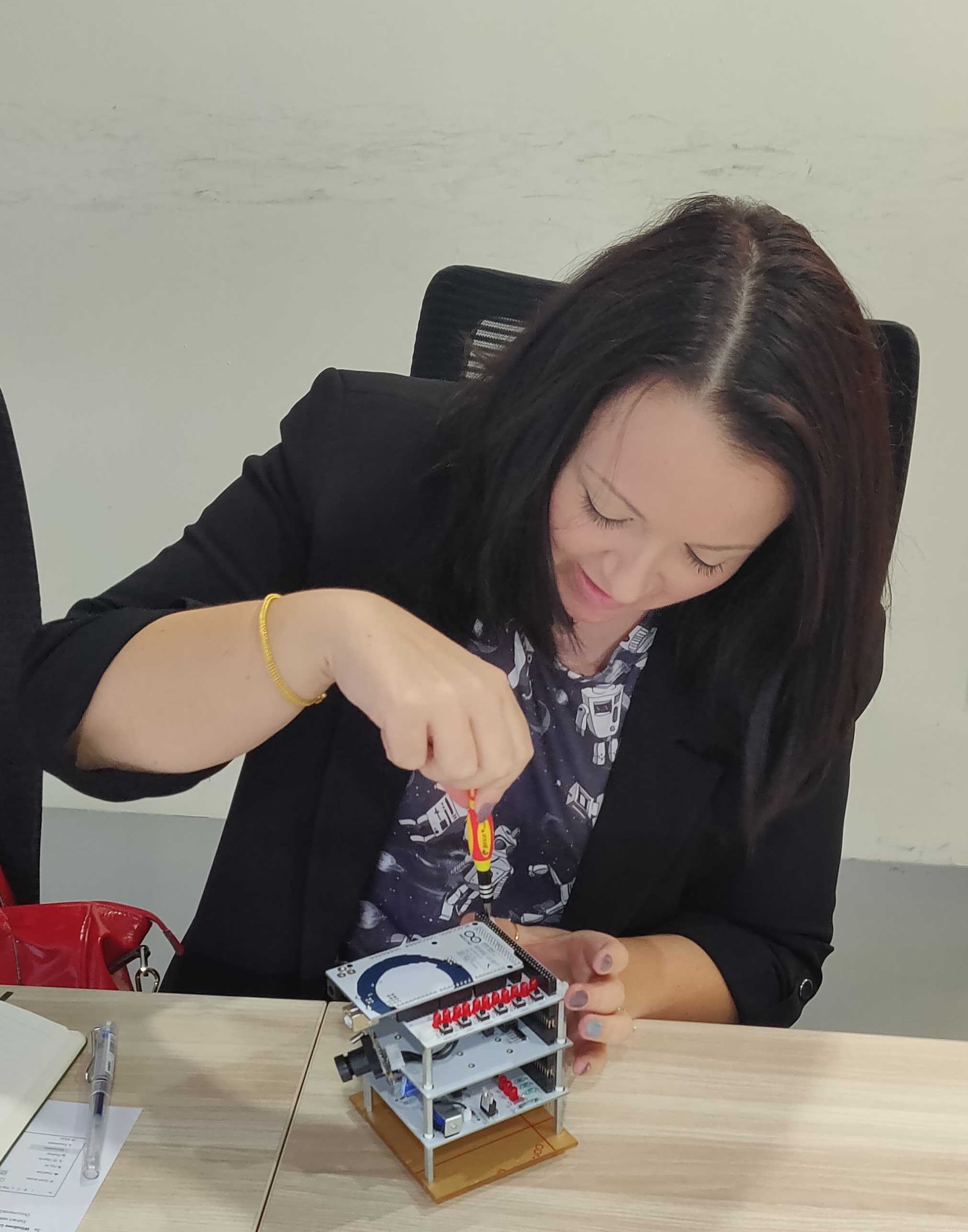
In November of 2019, in a small lab in Singapore, I was handed a screwdriver and asked to help bolt together a CubeSat the size of a shoebox.
I had agreed to come, I had read the brief, and nothing about the brief had prepared me for the actual moment of being asked to put a hand on the thing. The word nanosatellite had been carrying a great deal of weight in my head, conjuring something I would not be allowed near, behind glass, attended by people in white suits, untouchable in the same way the inside of an iPhone is untouchable. What was actually in front of me was a board, a small frame, a sequence of bolts, and a series of operations that needed to happen in the right order, talked through patiently by the technical lead while I tightened the wrong screw first and he did not flinch. The thing that had sounded intimidating turned out to be a thing you could open, the fanciness of the word had done all of the work to keep me at a distance, and the distance had been the only real barrier.
That photograph has come back a great deal in the past year, watching what is happening on the rest of the internet.
The cyberpunk that promised something
William Gibson wrote Neuromancer on a manual typewriter in 1983, in a small apartment in Vancouver, having never owned a computer, after spending several afternoons at a video arcade near his house watching teenagers play Galaga and Asteroids and noticing that the kids leaning into the cabinets seemed to believe there was a real space behind the screen, somewhere they were trying to get to. The book that came out of that observation, published in 1984, coined the word cyberspace, gave the world its first detailed picture of a cyberdeck (the portable interface its protagonists used to plug into the network), and laid out an argument that ran underneath the next decade of cultural production: the relationship between a person and their machines was being actively decided in real time, large corporations were going to win the fight by default if no one paid attention, and the only counterweight available was the population of people who insisted on keeping the case open and on understanding what was inside it.
From the typewriter the argument moved outward and found a much larger audience than the small literary scene that had launched it. It picked up a visual grammar through films like Blade Runner, Akira, Ghost in the Shell, and The Matrix, a print home through magazines like Mondo 2000 and the early Wired, and a working population through the BBS underground, which ran on phone lines and an unwritten code that nobody had to enforce because everyone using it had silently agreed to it. By the time the genre had run its first decade it had stopped being a literary movement and had become a cultural argument with adherents in places its original writers had never imagined, all of them organised around the same proposition: a person with the right curiosity and the right tools could meet the network on roughly equal terms, and the act of opening up the device, modifying it, and understanding what was inside was the precondition for everything else the future was supposed to make possible.
The decades that closed it
Most of what happened next is well documented. The PC era standardised, the iPhone shipped in 2007, the App Store followed in 2008, sealed aluminum became the dominant industrial design across the consumer category, pentalobe screws and soldered RAM and glued-in batteries made repair structurally hostile by design, every major device class consolidated into three or four sealed-platform vendors, the Genius Bar replaced the workbench, and the right-to-repair movement spent the next fifteen years fighting losing legal battles against John Deere, Apple, and Tesla while a series of US states passed mostly toothless versions of the legislation it had been pushing. The cyberpunk aesthetic survived intact in films, fashion editorials, and mood boards. The cyberpunk practice did not.
The newest layer of the same pattern is vibe coding, the term Andrej Karpathy gave to building software by talking to a model and shipping whatever it produces. Vibe coding gets framed as opening up software to people who never had access, which is partly accurate and partly the point of confusion, because what it actually does is add another opaque pane between the person and the system it generates, given that you can ship a working app without ever reading what runs inside it, and the moment something breaks, or you want to modify it, or you want to know what is doing the work, you are back at the same sealed surface that the iPhone introduced two decades earlier. The hardware analogue is the device with no service manual, the screws that strip if you try, the official line that says throw it away and buy the next one. Vibe coding can become exactly that, dressed in friendlier copy: trust the interface, do not look behind it, the inside is not for you.
The pattern, across both layers of the stack and across forty years of consumer technology, is the same: the inside of the system gets progressively further from the person using it, and the relationship that the original cyberpunks treated as the entire point quietly stops being on offer at all.
Who is actually building it now
The cyberpunk revival, as it turns out, is not arriving through magazines, hackathons, or the right-to-repair lobby. It is arriving through TikTok and Instagram, mostly in the format of fifteen-second build clips set to music, posted by a cohort that skews young, female, and unbothered by whatever the existing cultural script for a hardware tinkerer was supposed to look like.
Annike Tan, who posts as @ubeboobey, has built a Raspberry Pi cyberdeck inside a vintage minaudière covered in pearls, wired with a small keyboard and screen, and loaded with offline maps, music, books, and a working copy of Doom, and her videos on the build have been watched more than thirty million times since March of 2024. She frames the project explicitly: cyberdecks should be gatekept from AI and megacorp. Her audience, she has said in interviews, is roughly three-quarters women.
Gab Bois, the Montreal artist whose ongoing practice has involved repurposing discarded consumer electronics into wearables and household objects, released a 2025 capsule with Back Market called F/W 2005: Hardwear, in which earphones became headwear, a Discman became a compact mirror, and a full Y2K wardrobe ran on actual repaired hardware, with proceeds going to a right-to-repair organisation. The press release described it as “Y2K, but on steroids,” which slightly undersold the move; the capsule was making an argument that the hardware most people already own is reusable, modifiable, shareable, and capable of being beautiful in ways the original brief never anticipated.
Emma Orhun (@emmaorhun), a twenty-five-year-old creative technologist based in Ottawa, has built her own AirPod earrings and a Tamawatchi (a Tamagotchi crossed with an Apple Watch), and she talks openly about merging the exteriors of beloved Y2K objects with the hardware of modern devices.
The cohort widens substantially from there: @createdbyyeo, @vanyswolltanz, @ayeeeitsari, @tankgirltapes, @storyrichtich, @raspimaniax, @geo.kash, and @an_improbable_future each work a different angle (soldering tutorials, vintage electronics repair, modded enclosures, wearables, fan-made handhelds, kit-bashed peripherals), with the institutional ballast running underneath through @adafruit (which Limor Fried has been building into one of the most important hardware companies in the world for the last two decades), @theghostintheshellofficial (run more like a cyberpunk culture page than a film account), and the press paying attention through outlets like @verge and WIRED.
A short note on the press framing, since it is worth registering. The mainstream coverage so far has tended to put “girls” or “women” in the headline as the load-bearing element of the surprise, which says rather more about the assumed default builder in the public imagination than about who actually shows up to build, and the creators themselves do not appear especially invested in the framing.
None of it is necessary, which is the entire point
The most underrated thing about this revival is that nothing inside it is necessary. Annike Tan does not need a pearl-encrusted cyberdeck running Doom because she has a phone, Emma Orhun does not need AirPod earrings because she has the AirPods, Gab Bois does not need a Discman compact mirror because the original mirror works, and the larger cohort is not building handheld peripherals or modded enclosures because the existing consumer electronics market has failed to provide a viable alternative. The whole project is, by design, fully optional, structurally unproductive in the consumer-tech sense, and adjacent rather than competitive to the existing device market.
That uselessness is exactly what makes the trend a sharper signal than anything happening at the productive end of the stack. The dominant arc of computing for the last several years has bent toward warehouse scale, frictionless interface, and effortlessness, with generative AI as the apex of the same arc, most of the heavy work done in three companies’ data centres, behind the glass of an API, the user supplied with output and nothing else. That arc has its merits and is not going anywhere. It has also produced an environment in which the person using the technology is structurally further than ever from the technology itself, and the texture of having made something with your hands has been quietly engineered out of the standard consumer experience.
Doing something unnecessary, by hand, in small batches, with screws and a soldering iron and a free evening, is the form a refusal of that arc takes, and what it amounts to is a quiet insistence that this kind of making is still permitted to anyone with a workbench, that the relationship the original cyberpunks described is still on the table, and that the act of building a small thing badly is a more interesting use of an evening than scrolling. The cyberdeck builders are not trying to win, scale, displace, or argue with anyone, they are publishing the build clips and going back to the bench, and the act itself is the entire message.
The same instinct, one stack up
The same impulse, expressed in a completely different visual register, is the spine of the local-LLM and self-hosting cohort that has been quietly compounding alongside the cyberdeck revival. The people running Llama or Mistral or Qwen on a Mac Studio or a 4090 box, hosting their own inference, joining the long technical thread on r/LocalLLaMA, building a small private setup that does not need an API key, are doing exactly what the cyberdeck girls are doing, one layer up the system. None of that is necessary either, because cloud LLMs work fine and self-hosted ones cost more in setup time, electricity, and ongoing tinkering than the equivalent API call ever would, in the same way that a Plex server is more work than Netflix, a Mastodon node is more work than Twitter, and a Nextcloud instance is more work than Google Drive.
The unifying logic underneath all of these decisions is not efficiency and not protest, it is a refusal to outsource the entire surface of one’s daily computation to systems one cannot inspect, and a willingness to pay in setup time, electricity, and friction to keep a small piece of the stack within reach. The cyberdeck and the local model live at different layers of the system, and the impulse animating both is the same: to treat the stack you depend on as something you partially own and can put a screwdriver to, rather than something rented in perpetuity from people you will never meet.
What is worth watching
The interesting thing about this entire revival is not whether it is going to win, because it is not. The cloud will not be replaced by Mac Studios in bedrooms, the AI infrastructure of the next decade will not live in pearl-encrusted minaudières, and the right-to-repair movement will continue losing about half its legal fights for the foreseeable future. The point sits underneath that. A small, self-organising group of people, mostly young and many of them women, are choosing to spend their free time in deliberate, joyful, unauthorised friction with the dominant technological arc of the decade, and they are publishing the friction as evidence that this kind of relationship to one’s own machines is still available to anyone willing to pick the thing up. The thing being made is small, the thing being refused is enormous, and the only question worth holding onto is whether the rest of us still notice when somebody hands us the screwdriver.